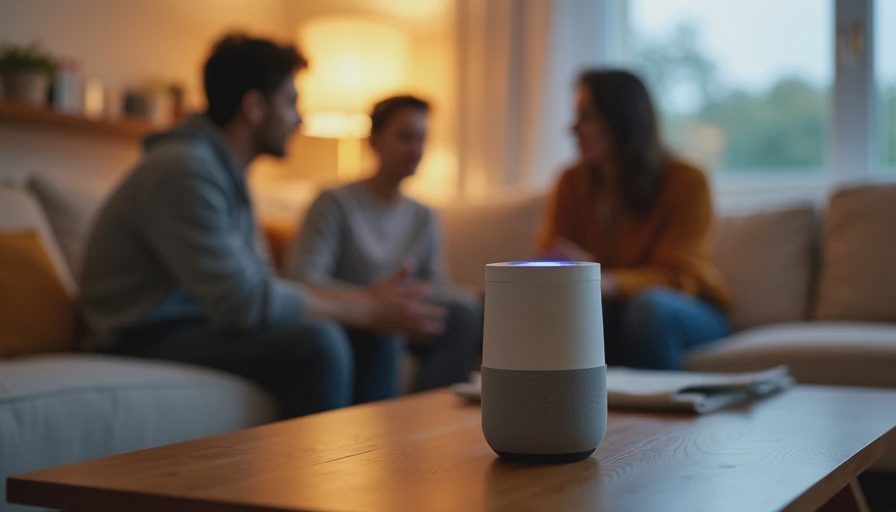
Smart speakers and voice assistants are convenient. They set timers, play music, answer quick questions, control lights, and let people speak requests instead of hunting for a phone. They also listen for wake words, process audio in the cloud for most common tasks, and store interaction history by default on many platforms.
Most households adopt these devices without a deliberate conversation about what that always-available microphone means in shared space. The result is usually a quiet mismatch: one person assumes the device is essentially inert until spoken to, another is uncomfortable with any persistent listening, and children treat it as a permanent audience or a toy. Small frictions accumulate—arguments about whether the speaker belongs in a bedroom, uncertainty about what was recorded, or a general sense that the house is less private than it used to be.
A short, explicit conversation prevents most of that drift. It does not require technical expertise. It requires the household to decide, out loud, what level of always-ready voice access is acceptable and under what conditions.

Why This Conversation Is Different from Other Tech Decisions
A smart speaker is not like a phone or a laptop. It is a shared environmental device. Its microphone sits in common space. Its default behavior is to listen for a trigger phrase. Its records, when enabled, can include voices of anyone in the room—including guests and children who never agreed to the terms of service.
Because the device is ambient, individual preference collides with household reality. One person’s convenience becomes everyone’s soundscape and everyone’s potential data trail. That is why a private, individual decision is usually insufficient.
What Often Goes Unsaid
Who is comfortable being recorded in the background of someone else’s request?
Are there rooms where a microphone should simply not be present?
What happens to voice history, and who can review or delete it?
How will the household handle children’s voices and children’s requests?
Is the convenience worth the standing permission the device requires?
Leaving these questions implicit produces resentment or quiet workarounds rather than a stable arrangement.
The Core Questions the Household Should Answer
A productive conversation stays concrete. Abstract debates about “privacy versus convenience” rarely resolve. Specific decisions do.
1. Where Are These Devices Allowed?
Not every room has the same stakes.
Common areas (kitchen, living room) are the strongest candidates for shared voice control.
Bedrooms and bathrooms raise different comfort levels for many people.
Children’s rooms introduce both privacy and developmental questions.
Decide room by room rather than treating the entire house as a single zone. It is entirely reasonable to have a speaker in the kitchen and none in the bedrooms.
2. What Is the Device Allowed to Hear and Store?
Most platforms offer settings that limit how long voice recordings are kept, whether they are used to improve the service, and whether human review is permitted. These settings are not identical across brands, and the defaults are usually not the most private options.
The household should decide:
Is voice history retained, and for how long?
Is the history used for advertising or product improvement?
Does anyone in the house want the ability to review or bulk-delete past requests?
Then one adult should implement those choices and confirm they stuck after the next software update.
3. How Will Children’s Use Be Handled?
Children treat smart speakers as permanent listeners and instant answer machines. That creates two separate issues: data about children, and the habit of outsourcing curiosity or compliance to a device.
Decide in advance:
Are children’s voices and requests acceptable data for the service?
Are there topics or request types that should be redirected to a person instead of the speaker?
Will the household use any child-specific voice profiles or filters, and who manages them?
Clarity here prevents later arguments when a child starts issuing orders or asking questions the adults find inappropriate for an always-on microphone.
4. Who Owns the Account and the Settings?
Someone must be the practical administrator. That person should be known to the household, and a second adult should be able to access the account if needed. Settings that only one person understands tend to drift back to defaults or become sources of conflict.
5. What Is the Exit Condition?
Circumstances change. A device that feels acceptable today may not feel acceptable after a change in household composition, a news event about the platform, or a simple shift in comfort level. Agree that any adult can reopen the conversation and that removing a device from a room is a legitimate outcome, not a failure.
A Lightweight Conversation Structure
The discussion does not need to be long or formal. Thirty focused minutes is usually enough.
Suggested flow:
List the smart speakers and voice-enabled devices currently in the house and where they sit.
Ask each adult (and age-appropriate children) what feels useful and what feels uncomfortable.
Walk through the five core questions above and record the decisions in plain language.
Assign one person to implement the agreed settings within a short, defined window.
Set a light review point (for example, three months later or after any major platform change).
Write the decisions down. Memory is unreliable, and settings pages are easy to forget.
Practical Settings Worth Checking
Exact menus differ by platform, but most major voice assistants offer controls in these areas:
Voice recording retention period (or auto-delete after a set time)
Whether recordings may be used to improve the service
Whether human review of voice clips is allowed
Mute or power-off behavior and how easy it is to use
Companion app notifications related to voice activity
Child-specific profiles, filters, or linked accounts
After changing settings, verify them a week later. Updates sometimes reset preferences or introduce new defaults.
Trade-Offs the Household Should Accept Honestly
Choosing to keep smart speakers means accepting some level of ambient listening for wake-word detection and, in most cases, cloud processing of requests. Choosing to remove them means giving up a form of convenience that many people value, especially for timers, music, and quick hands-free control.
There is no universal correct answer. There is only the arrangement the actual people in the house can live with without ongoing resentment. Some households keep speakers only in the kitchen and keep them muted at night. Others keep none. Both can be rational outcomes of the same conversation.
What does not work well is the middle state in which devices are present, settings are unexamined, and discomfort is never discussed.
Signs the Current Arrangement Needs Revisiting
Someone regularly mutes a speaker or unplugs it when certain people are home.
Children treat the device as an authority or as a private confidant in ways that feel unhealthy.
No one is sure what the retention or review settings currently are.
Guests express surprise or discomfort, and the household has no clear explanation of the device’s behavior.
The original convenience no longer feels worth the background awareness of being potentially recorded.
Any of these is sufficient reason to reopen the discussion.
The Standard for Keeping the Devices

A smart speaker earns its place when:
The household has explicitly agreed on locations and basic data settings.
The convenience is still noticeable in daily routines.
Any discomfort has been addressed rather than suppressed.
Settings are known, documented, and occasionally verified.
Removing or relocating a device remains an acceptable option.
If those conditions are not met, the device is adding quiet friction even while it answers questions and sets timers.
Technology that lives in shared space requires shared decisions. A single conversation will not settle the topic forever, but it will replace assumption and low-level tension with a clear, revisable agreement.
Before you leave another always-listening device in a common room, make sure the household has decided it is something everyone can live with.


No letters yet — be the first guest to write.