A growing number of household devices now ship with a second price tag: the monthly or annual subscription required to keep core features working. Cameras that record only with a cloud plan. Robot vacuums that map more effectively behind a paywall. Fitness equipment that locks routines behind a membership. Smart displays and speakers that limit voice history or multi-user features unless you pay ongoing fees.
Some of these subscriptions deliver clear, continuing value. Others function as rent-seeking: charging repeatedly for functionality that used to be included, or that costs the company very little to provide once the hardware is sold. Distinguishing between the two is essential if a family wants a technology stack it can actually afford to keep.
The test is not whether the subscription is cheap. The test is whether it continues to solve a real problem at a fair ongoing cost, and whether the alternative (living without it, or choosing different hardware) is worse.
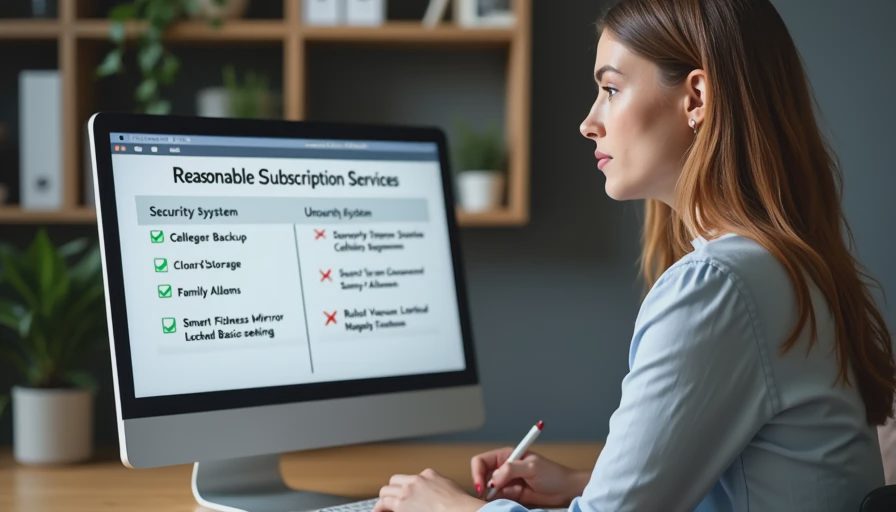
The Spectrum of Device Subscriptions
Not every recurring charge is the same. They fall along a practical spectrum.
Subscriptions That Often Justify Themselves
These typically share several traits:
They provide an ongoing service that has real marginal cost (storage, monitoring, cellular connectivity, human review).
The hardware remains useful even if the subscription is canceled, even if some convenience is lost.
The price is transparent and proportionate to the service delivered.
Canceling is straightforward and does not brick the device.
Examples that frequently pass the test for many households include cloud storage that actually holds a large family photo library, cellular backup connectivity for a security system when the home internet fails, and certain content libraries that are used regularly rather than occasionally.
Subscriptions That Often Lean Rent-Seeking
These tend to show different patterns:
Basic functionality that previously worked locally is moved behind a recurring fee.
The hardware is materially degraded or limited without the subscription.
The ongoing cost quickly exceeds the original purchase price.
The service provided has near-zero marginal cost to the company after the initial setup.
Cancellation is friction-filled or the company relies on consumers forgetting they are subscribed.
When a device requires a subscription to perform the job it was originally sold to do, the purchase price is no longer the real price. The real price is the hardware plus the cumulative subscription cost over the years the device remains in the home.
A Practical Decision Framework
Before accepting any device subscription, run it through four questions. Honest answers matter more than the marketing language.
1. What Exactly Stops Working Without the Subscription?
List the features that disappear or degrade. Then separate them into two groups:
Features that are essential to the device’s primary job
Features that are convenient but secondary
If the primary job requires the subscription, the device is not really a one-time purchase. Factor the subscription into the original buying decision as a mandatory cost of ownership.
2. What Is the Three-Year Cost?
Multiply the subscription by 36 months and add it to the hardware price. Compare that total to alternatives:
A competing device with fewer or no required fees
A simpler non-connected version of the same tool
Doing without the feature entirely
Many “affordable” devices become expensive once the three-year number is visible. A $100 camera plus a $6/month plan is a $316 camera after three years—before any price increases.
3. Does the Service Have Genuine Ongoing Cost?
Cloud storage, cellular data, professional monitoring, and regularly updated content libraries have real costs. Local features that are simply software-locked do not. When a company charges monthly for something that runs entirely on hardware you already bought, skepticism is warranted.
4. How Easily Can You Leave?
Test the cancellation path before you need it. Prefer services that:
Allow cancellation in the account settings without requiring a phone call
Continue to provide basic local functionality after cancellation
Do not punish you with deleted history or permanent feature loss that should have been local
High exit friction is a signal. Companies that make it hard to leave often depend on inertia rather than continuing value.
Common Household Categories Examined
Security Cameras and Doorbells
Cloud video history is the most common subscription in this category. Continuous or extended recording, intelligent alerts, and multi-camera management often require a plan.
Often worth it when:
The household values accessible video history, the plan is used regularly (not just “in case”), and local storage options are absent or impractical.
Often rent-seeking when:
Basic motion clips or short history that once came with the device are now paywalled, or the subscription is required for features that could reasonably run on-device.
Robot Vacuums and Mops
Some models restrict advanced mapping, no-go zones, or multi-floor memory to a premium account.
Often worth it when:
The subscription unlocks meaningfully better navigation in a complex floor plan and the household uses the robot frequently enough to benefit.
Often rent-seeking when:
Core cleaning schedules or basic mapping are limited without payment, turning the hardware into a lesser device the moment the trial ends.
Smart Home Hubs, Lighting, and Appliances
A smaller but growing number of products now gate automations, remote access, or energy insights behind a fee.
Often worth it when:
The fee supports genuine remote infrastructure or advanced energy management that produces measurable savings or convenience.
Often rent-seeking when:
Local automations or basic remote on/off control require a subscription. These capabilities have become table stakes and should not be metered monthly.
Fitness and Health Devices
Connected bikes, watches, and scales frequently pair hardware with content or advanced metrics subscriptions.
Often worth it when:
The content or coaching is used consistently and replaces a more expensive alternative (gym membership, classes).
Often rent-seeking when:
Basic metrics or device functionality are locked, or the subscription is priced for heavy users but sold alongside hardware marketed to casual ones.
How to Protect the Household Stack
Prefer Hardware That Degrades Gracefully
When comparing products, give weight to what still works if the subscription is later canceled. Devices that remain useful at a reduced feature set give the household future flexibility. Devices that become significantly less capable create lock-in.
Calculate Before You Buy, Not After
Treat the subscription as part of the purchase price. If the three-year total feels high relative to the problem being solved, walk away or choose a different product. The best time to reject rent-seeking is before the hardware is on the shelf.
Audit Existing Subscriptions Quarterly
Many households accumulate device-related plans that no longer match usage. A short quarterly review—list every device subscription, note the last time its premium features were used, and cancel the ones that no longer clear the bar—usually recovers more money than any individual shopping decision.
Resist Trial-to-Paid Inertia
Free trials are designed to convert through convenience and forgetfulness. Calendar a reminder before the trial ends. Use the trial period to test whether the premium features actually change daily behavior. If they do not, cancel before the first charge.
The Standard for Keeping a Subscription
A device subscription is worth keeping when:
It solves a recurring problem the household still has
The ongoing cost is proportionate to the value received
The alternative (no subscription or different hardware) is meaningfully worse
Cancellation remains available without punishing the hardware
If those conditions are not met, the subscription is closer to rent-seeking than to a fair service relationship. In that case the cleaner decision is to cancel, replace the device when the time comes, or avoid the product category until a more honest model appears.
Household technology should reduce friction and justify its cost over time. Subscriptions that primarily extract payment for what the hardware already enables move the stack in the opposite direction.
Before you accept the next device subscription, make sure it is something you are willing to keep paying for—and that the device itself remains worth living with if you ever stop.



No letters yet — be the first guest to write.